Fixtures
Only where the portal has RDM.
Available on Designer LPC Family, Designer MSC Family, Express, Animate, Perform
The Fixtures tab reports the status of the luminaires attached to a device. It polls them over RDM, shows you which are online, and lets you replace a faulty one remotely — setting the replacement's mode and address and patching it into the existing programming without uploading a new project file.
Fixture status has prerequisites: a recent enough device firmware version, fixtures that support RDM, and UIDs set in the project file. The site's fixtures tab rolls status up across every device in the site.
Fixtures and RDM devices
A fixture is an entry in your project file. An RDM device is a physical responder that answers a poll. Most fixtures are one device, but a fixture can contain several — which is why the table has two levels, and why a fixture can be partially offline.
Fixture status monitoring and your subscription
A message at the top of the tab records that, while fixture status monitoring is being introduced, the Fixtures tab is included in your standard Cloud subscription, and that you will be told in advance if that is going to change. Dismissing the message hides it for you on this site; it turns nothing off.
Fixture status
A fixture's Status is a coloured marker, named by the tooltip it carries. The site summary counts the same four, but the dashboard has its own wording for two of them, so the third column below is the word to look for there.
| Marker | Meaning | On the site summary |
|---|---|---|
| Online | Every RDM device in the fixture responded to the last poll | Online |
| Partial | Some of the fixture's RDM devices responded and some didn't | Partially Online |
| All offline | No RDM device in the fixture responded | Offline |
| Status unknown | Nothing has been polled for this fixture at all — usually one with no RDM UID in the project file. Grey, rather than coloured | No Data |
A responder discovered that isn't attached to any fixture in the project has no fixture status of its own. It appears in the unassigned devices panel described below, and the site summary counts it separately, under Unassigned Devices.
Status Changed gives the time of the poll that last moved a fixture between statuses, so a stale timestamp means stable rather than unmonitored.
These are the columns the list carries.
| Column | What it holds |
|---|---|
| # | The fixture's number in the project file |
| Name | Its name in the project file |
| Manufacturer | Reported by the fixture over RDM |
| Model | Reported by the fixture over RDM |
| Custom Properties | How many custom properties the fixture carries |
| Notifications | Whether this fixture is included in fixture status notifications |
| Status Changed | When its status last changed |
| Status | The status above, as a coloured marker |
The number and the name are both there because a project file is free to reuse a name: the number is what identifies a fixture, and it is what the replacement dialogs name it by.
- Unassigned devices
A collapsed panel at the top of the page, appearing when a poll finds a responder that isn't in the project. Its heading carries the number found in brackets, and it lists each one by Uid, Output and Manufacturer.
- RDM fixtures only
The table lists every fixture in the project by default, including ones with no RDM UID configured that Cloud can't report on. Select this to hide them.
- Search
- Filters the list by fixture name.
- Refresh All
Runs a full status refresh on this device, polling all of its RDM devices. It can take a few moments depending on how many fixtures are in the project, and it asks you to confirm first: a poll can momentarily disrupt lighting output.
- Notifications
Set per fixture. If turned off, events from that fixture are left out of fixture status notifications entirely.
Custom properties
A project file can attach arbitrary properties to a fixture — a circuit reference, a position, an asset number. The Custom Properties column counts them, and expanding the row lists them as Property and Value pairs above the fixture's RDM devices. Neither the column nor the table appears on a device whose project file sets none.
RDM devices within a fixture
Select the arrow at the left of a fixture's row to expand it and list the RDM devices belonging to that fixture.
| Column | What it shows |
|---|---|
| ID | The device's RDM UID |
| Patch | Protocol and address, such as dmx:1 |
| Status | Last known status: Online green, Missing red, or grey for a responder the device has never reported on, whose marker reads Unknown |
| Updated At | When the last poll updated it |
| Mode | Current operating mode — editable |
| Start Address | Current DMX start address — editable |
| Curve | Dimming curve — editable |
The three editable columns write straight to the luminaire, so choosing a value asks you to confirm it first: Confirm Change repeats the value you picked, and nothing is sent until you select Confirm. A mis-clicked dropdown therefore never reaches the fixture.
Refresh Fixture polls just this fixture, which is quicker than Refresh All when you are checking one repair. It asks for the same confirmation that Refresh All does.
Device options
The Options menu on each row changes with the device's status.
When online
Identify On and Identify Off make the luminaire announce itself, so someone on site can find it.
When missing
A responder that stopped answering polls is offered one entry instead of the pair above.
Replace opens the Replace missing device dialog, with this responder as the one being replaced.
An unassigned device offers all four: Identify On, Identify Off, Replace device and Add to fixture.
Adding a new device
Select a discovered Unassigned device option menu and select Add to fixture. In the following modal, select a target fixture and set parameters for the new device.
This device will then be added as part of the fixtures' devices and contribute to its online status.
Replace a faulty fixture
You can swap out a missing or faulty fixture entirely from Cloud. Once the replacement hardware is connected, Cloud configures it and updates the existing programming to use it — no on-site commissioning, no new project upload.
1. Connect the replacement. Arrange for the new fixture to be installed and connected, which usually means an engineer attending site. They need do nothing beyond that; mode, start address and project assignment are all set remotely.
2. Refresh fixture status. Select Refresh All. The new fixture appears under Unassigned Devices.
3. Open the replacement tool. Two routes, depending on where you start. They open different dialogs, so pick the one that matches what you are looking at:
From Unassigned devices
Use this route when you are starting from the replacement hardware.
Expand Unassigned Devices at the top of the page. The new fixture is listed there.
Select Options > Replace device, then choose the device to be replaced under step 1. That list names every assigned responder by its fixture # and Fixture name, so two fixtures sharing a name stay distinguishable.
From a missing device
Use this route when the responder being replaced is already showing as missing — it is quicker, and the dialog knows which device it is about.
Expand the fixture's row, find the missing device and select Options > Replace. That opens a different dialog, in which step 1 asks for the incoming device instead: see Replace a missing device below.
4. Set the incoming device's parameters. These are applied to the replacement: Mode, Start Address and Curve. Set them to suit the installation.
5. Review and commit. Step 3 spells out which RDM device is being unassigned and which is taking its place, naming the fixture by number and name. Read it, then select Commit.
Replace a missing device
Starting from a responder that has gone missing runs the same swap the other way round: the fixture and the outgoing device are already known, so the dialog only has to be told which discovered responder replaces it. Its title names the responder being replaced.
1. Choose the incoming device. 1. Select an unassigned device for replacement lists the responders this device has discovered but has no fixture for. Where exactly one has been found it is chosen for you.
2. Set the incoming device's parameters. The same Mode, Start Address and Curve as above, applied to the responder coming in.
3. Review and commit. The review names both responders and the fixture they are moving between.
Schedule status refreshes
Status is only as current as the last poll, so on most projects it's worth polling on a schedule rather than by hand. Polling is configured in the project file, so the steps differ by system.
Either way, results are published to Cloud as soon as the poll finishes and appear on the Fixtures tab at both device and site level.
Designer
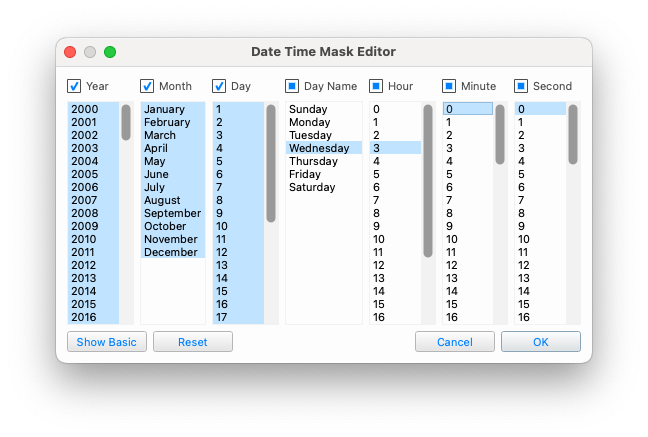
Create a Real Time trigger with a Start RDM Poll action.

Set the Date Time Mask Editor to the frequency you want. The example below fires at 3am every Wednesday: every year, every month, every day of the month, but only where the day name is Wednesday and the time is 03:00:00.
Express
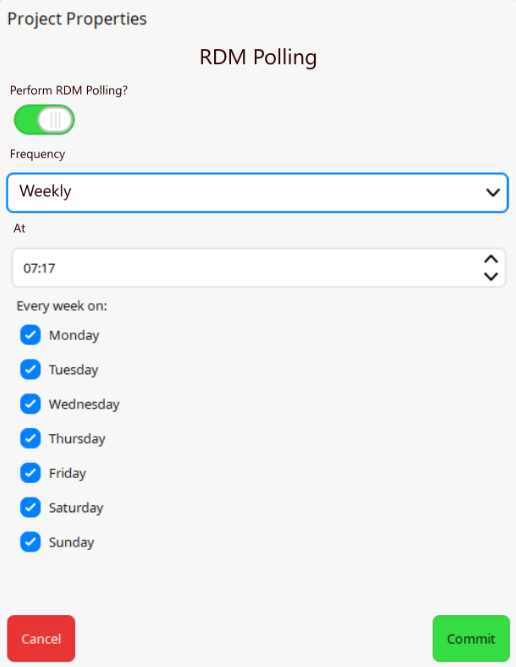
Go to Main Menu > Edit Project Properties... > RDM Polling.
Turn on Perform RDM Polling?, choose a Frequency and the time to poll At. A weekly frequency also lets you pick which days. Select Commit.
Get notified when a status changes
Cloud checks each set of poll results against the last known status and raises notifications for anything that has changed.
The Notifications toggle on this tab sets whether a fixture is included at all. Everything else is per user, on the site's Settings tab: scroll to notifications and expand fixture status.
Each of the four statuses can be sent Instant, Daily
or Weekly, set for the whole site under
APPLY TO ALL DEVICES or per device below it. The counts
beside each toggle — 4/4, 1/4 — show how many devices in the site that setting
currently covers, so a partial count means some devices have been set individually.
A common arrangement is instant alerts for Offline and a weekly summary for Online, which tells you about failures as they happen without a message every time something recovers.
The next poll that finds an offline fixture then sends an email naming the fixture and linking back to the site.